Answer Engine Optimization (AEO): Why “Ranking #1” No Longer Means What It Used To
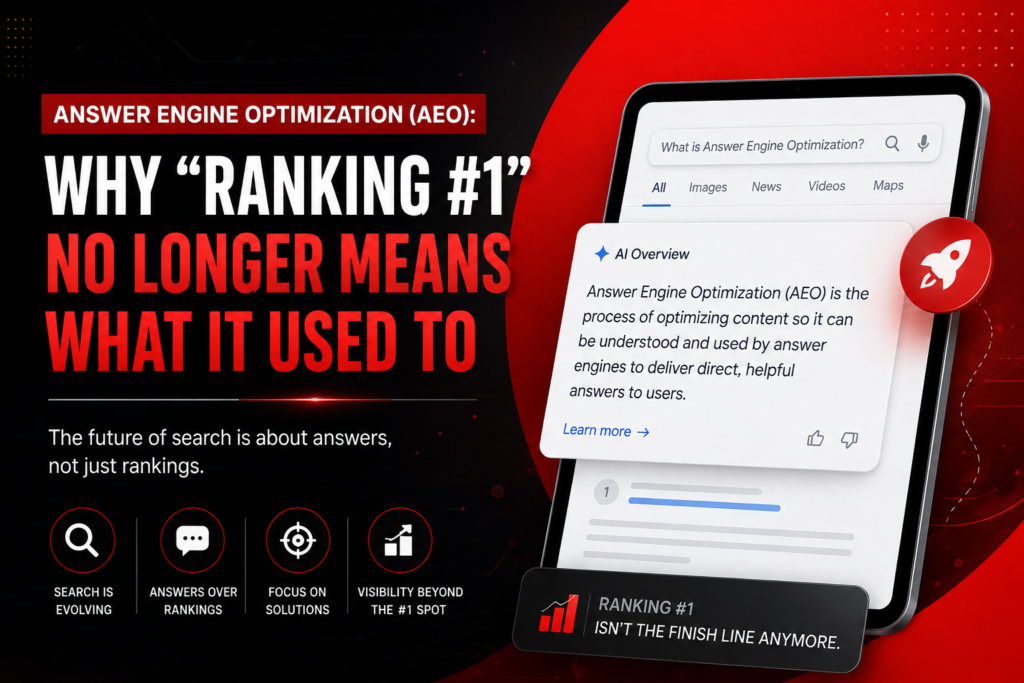
For almost two decades, digital marketers have lived and breathed one goal: rank on page one of Google. Blue links, meta descriptions, click-through rates — the entire SEO playbook was built around getting a human to click a result and land on your website. But something quietly seismic has happened over the last couple of years, and most brands haven’t caught up to it yet.
People are no longer clicking.
Between AI Overviews in Google Search, ChatGPT, Perplexity, Copilot, and voice assistants, a growing share of searches now end with an answer, not a link. The user asks a question, gets a synthesized response pulled from multiple sources, and moves on — often without ever visiting a single website. This shift has given rise to a discipline marketers are now calling Answer Engine Optimization, or AEO. If SEO was about earning a spot on the results page, AEO is about earning a spot inside the answer itself.
What Exactly Is AEO?
Answer Engine Optimization is the practice of structuring and writing content so that AI systems can easily extract, understand, and cite it when generating a direct answer to a user’s query. Instead of optimizing purely for crawlability and keyword relevance, AEO asks a different question: if an AI had to summarize my content in two sentences, would it choose mine — and would it get the facts right?
This isn’t a replacement for SEO. It’s an evolution that sits on top of it. Technical SEO fundamentals like site speed, clean structure, and authoritative backlinks still matter because AI engines rely on the same crawled web to build their answers. But AEO adds a new layer of discipline: clarity, extractability, and trustworthiness at the sentence level, not just the page level.
Why This Shift Matters More Than Marketers Realize
The uncomfortable truth is that zero-click searches were already rising before generative AI entered the picture. Featured snippets and knowledge panels had been quietly training users to get answers without clicking through. AI-powered search has simply accelerated a trend that was already underway, and it has raised the stakes considerably.
Consider what happens when someone asks an AI assistant, “What’s the best CRM for a small e-commerce business?” The assistant doesn’t list ten blue links for the user to evaluate. It picks a handful of options, explains the reasoning, and often names two or three brands by name. If your company isn’t one of them, you don’t just lose a click — you lose visibility in the moment that mattered most: the decision point.
This is why forward-thinking brands are starting to treat “Am I being mentioned inside AI-generated answers?” as seriously as “Am I ranking on Google?” It’s a different metric, a different battlefield, and frankly, a less mature one — which means there’s real opportunity for marketers willing to move early.
How AI Engines Actually Choose What to Cite
Understanding AEO requires understanding, at least at a practical level, how these systems decide what to surface. Large language models and retrieval-based search tools generally favor content that is:
Structurally clear. Content organized around direct questions and concise answers, using descriptive headers, gets extracted more easily than dense, meandering paragraphs. If a human skimming your page can find the answer in five seconds, an AI system can extract it in milliseconds.
Fact-dense and specific. Vague, marketing-speak-heavy copy (“we deliver best-in-class solutions”) gives AI systems nothing concrete to quote. Specific numbers, named comparisons, and clearly stated claims are far more citable.
Corroborated elsewhere. AI systems tend to trust information that appears consistently across multiple credible sources. A single unsupported claim on your site carries less weight than the same claim echoed across your site, a few reputable publications, and structured data markup.
Recently updated. Freshness signals matter more in an AI-search context than they historically did in traditional SEO, since users often ask time-sensitive questions and engines are wary of surfacing stale information.
Practical Ways to Start Optimizing for Answer Engines
You don’t need to overhaul your entire content strategy overnight. A few deliberate shifts can meaningfully improve how AI systems perceive and use your content.
Write in a question-and-answer structure. Identify the real questions your audience asks — not just keywords, but full natural-language questions — and answer them directly within the first sentence or two of a section. Save nuance and elaboration for after the direct answer, not before it.
Use structured data markup. Schema markup (FAQ schema, HowTo schema, Product schema) gives AI crawlers explicit, machine-readable signals about what your content means, not just what it says. This is one of the most underused levers in AEO right now.
Build topical authority, not just page-level optimization. AI engines appear to weigh a brand’s overall depth on a subject more heavily than a single well-optimized page. A cluster of interconnected, genuinely useful content around a topic outperforms one isolated “pillar page” stuffed with keywords.
Get cited, not just linked. Traditional link-building focused on domain authority. AEO rewards being referenced accurately across the web — in review sites, comparison articles, forums like Reddit and Quora, and industry publications — because these are exactly the sources AI models draw from when triangulating an answer.
Audit what AI is already saying about you. Before optimizing anything, ask ChatGPT, Perplexity, and Google’s AI Overview the exact questions your customers ask. See whether your brand appears, how accurately it’s described, and who’s being mentioned instead of you. This single exercise often reveals more strategic insight than a month of traditional keyword research.
The Brands Getting This Right
Early movers in AEO tend to share one trait: they’ve stopped writing content that merely ranks and started writing content that answers. They format pages around real customer questions, they publish original data and case studies that other sources end up citing, and they treat their own website as one node in a much larger web of trust signals — rather than the only asset that matters.
This doesn’t mean traditional SEO is dying. Websites still matter enormously; they’re the source material AI engines pull from, and they’re still where transactions ultimately happen. But the funnel has changed shape. Discovery and consideration increasingly happen inside an AI-generated answer, and only the final decision or purchase happens on-site. Marketers who treat these as separate battles — optimizing for both the answer and the click — will be the ones who stay visible as this transition deepens.
The Bottom Line
Search behavior is undergoing its biggest transformation since the mobile shift over a decade ago. Answer Engine Optimization isn’t a buzzword to bolt onto your existing strategy; it’s a genuine rethink of what “visibility” means when the audience is often a machine synthesizing an answer on someone else’s behalf. Brands that adapt now — by writing more clearly, structuring content around real questions, and actively tracking how AI systems talk about them — will have a meaningful head start over competitors still optimizing purely for 2015-style SEO.
The question every marketer should be asking isn’t just “How do I rank higher?” anymore. It’s “If an AI had to describe my brand in one sentence, would it even know what to say?”
Ready to make sure your brand shows up in the answers, not just the search results? Whether you need an AEO-ready content audit, a refreshed SEO strategy, or a full digital marketing plan built for how people actually search today, let’s talk. Reach out to start building a strategy that keeps you visible — wherever your customers are asking questions.